


Ishiba‘s US visit a test of Tokyo’s balance in power game
作者:孙家珅 来源:《环球时报》英文版2025年2月9日 时间:2025-02-11
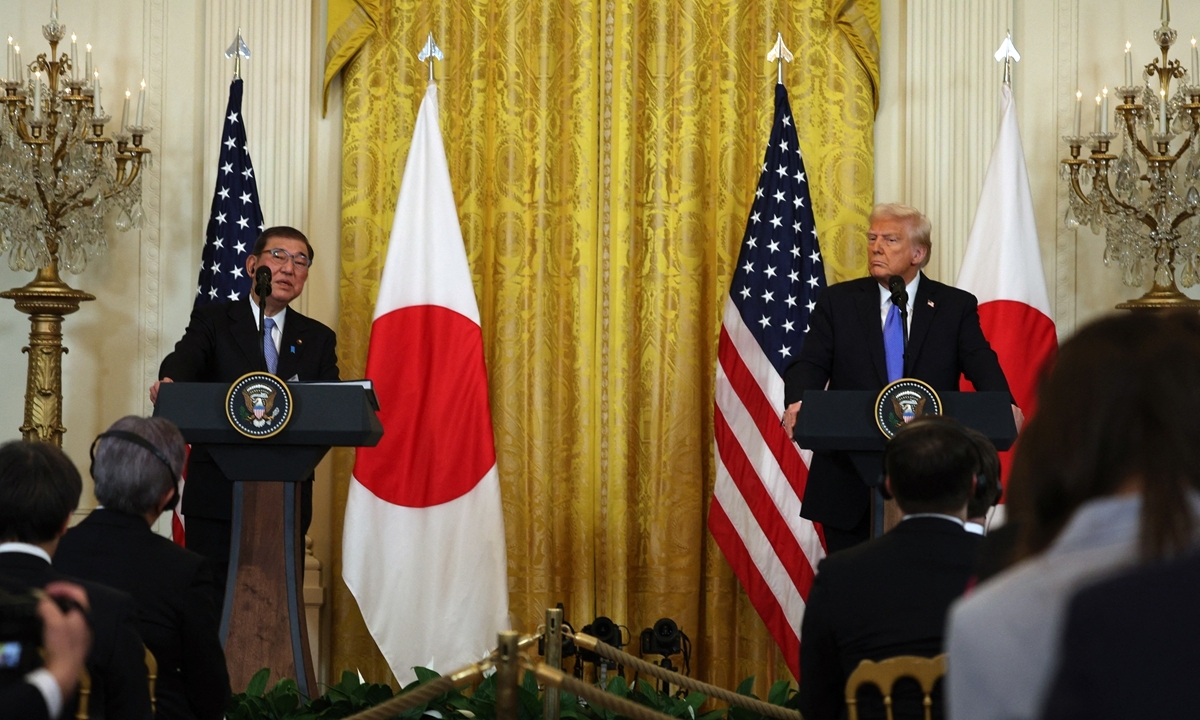 During his visit to the US from Thursday to Saturday, Japanese Prime Minister Shigeru Ishiba held his
first in-person summit meeting with US President Donald Trump. This visit was widely seen as a critical
step in Japan's efforts to recalibrate its diplomacy and alliance with the US in the "Trump 2.0 era." Ishiba's
trip carried multiple political objectives: first, to reinforce the US-Japan alliance and prevent the Trump
administration from exerting excessive pressure on Japan; Second, to leverage diplomatic achievements to offset
challenges within a country's internal affairs and boost support for his cabinet.
According to the joint statement after the meeting, the two sides agreed to further strengthen their deterrence
and response capabilities by enhancing defense and security cooperation. The US "welcomed Japan's commitment,
underpinned by a favorable trend of its defense budget increase, to building capabilities by FY 2027." Ishiba
also "conveyed his willingness to cooperate together to elevate Japan's investment in the US to an unprecedented
amount of one trillion dollars."
But these apparent gestures of "sincerity" only underscore Japan's passivity in its foreign policy toward the US.
The Trump administration continues to uphold the "America First" doctrine, seeking economic and strategic benefits
from Japan through demands on troop funding and trade imbalances. The US now plans to implement "reciprocal tariffs"
on many countries, which could force Japan to make concessions in agriculture and automotive industry. Just last month,
the Joe Biden administration blocked the acquisition of US Steel by Japan's Nippon Steel, further exposing US double
standards toward its allies and highlighting the deepening contradictions within the US-Japan alliance.
Although the joint statement from the Trump-Ishiba summit grandly proclaimed the goal of pursuing a "new golden age"
for US-Japan relations, divergences between the two countries persist. In terms of economic interests, Washington's
"America First" policy clashes with Japan's aspirations for independent diplomacy. While Tokyo hopes to avoid tariff
hikes, the US may still pressure Japan over trade deficits, making future economic cooperation fraught with challenges.
In addition, Tokyo's defense spending commitments fell short of US expectations.
On the issue of strategic autonomy, the Ishiba administration has sought a more independent autonomy for Japan.
In response to Trump's "America First" policy, Japan has been exploring diversified diplomatic pathways, including
strengthening ties with China and Southeast Asian countries. Before visiting the US, the Japanese leader hinted at
his desire to visit China as soon as possible, emphasizing the need for stable China-Japan relations. Meanwhile,
Japanese politicians and officials visiting China and the appointment of Liberal Democratic Party (LDP) Secretary
General Hiroshi Moriyama as the new chairman of the Japan-China Friendship Parliamentarians' Union provide potential
for improved relations.
However, the joint statement from the US and Japanese leaders hyped up issues related to the East China Sea and the
South China Sea, explicitly claiming the two leader's opposition to so-called "any attempts by China to change the
status quo by force or coercion in the East China Sea" and vowed to "increase bilateral presence in Japan's Southwest
Islands." This demonstrates that the US is still trying to pull Japan into Washington's China-containment framework,
which will severely restrict the Ishiba administration's pursuit of strategic autonomy. Although the Japanese leader
appears inclined to adjust Japan's foreign policy, his strategic autonomy remains constrained by pro-US factions
within the LDP and pressure from Washington.
Currently, a growing number of Japanese politicians are revisiting the "Small Japan Policy" and independent diplomacy
doctrines of former Japanese prime minister Tanzan Ishibashi, reflecting on the pitfalls of overreliance on the US and
advocating a more pragmatic, balanced foreign policy. However, if the Ishiba administration compromises excessively with
the US at the cost of China-Japan relations or fails to navigate between geopolitical complexcities, Japan risks losing
both economic and strategic leverage.
Thus, Ishiba's visit to the US demonstrates a test of Japan's ability to carve out space to survive in the game between
China and the US. Japan should adopt a pragmatic approach to advancing dialogue with China and avoid fueling bloc
confrontation by siding with the US against China. Only by adhering to open cooperation can Japan break free from
zero-sum constraints and contribute to regional and global stability.
来源:《环球时报》英文版2025年2月9日;作者:孙家珅,中国社会科学院日本研究所助理研究员。